

NewAthena X-ray Advances: NASST and ACO Science Webinars
Beginning in 2022, the ASST and ACO launched the “Athena X-ray Advances: ASST & ACO Science Webinars”, which were reformulated in November 2023 as “NewAthena X-ray Advances: NASST & ACO Science Webinars.” These science seminars focus on the scientific case for NewAthena and aim to keep the NewAthena community informed about exciting developments relevant to Athena’s capabilities. The series is primarily intended for members of the NewAthena community but is open to the wider astronomy community.
Each webinar in the series is broadcast via Zoom Webinars. To facilitate live participation from a broad international audience, seminars are typically held from 15:00 to 16:00 CEST/CET. Recordings of the webinars are archived on the ACO YouTube channel.
Coming webinar
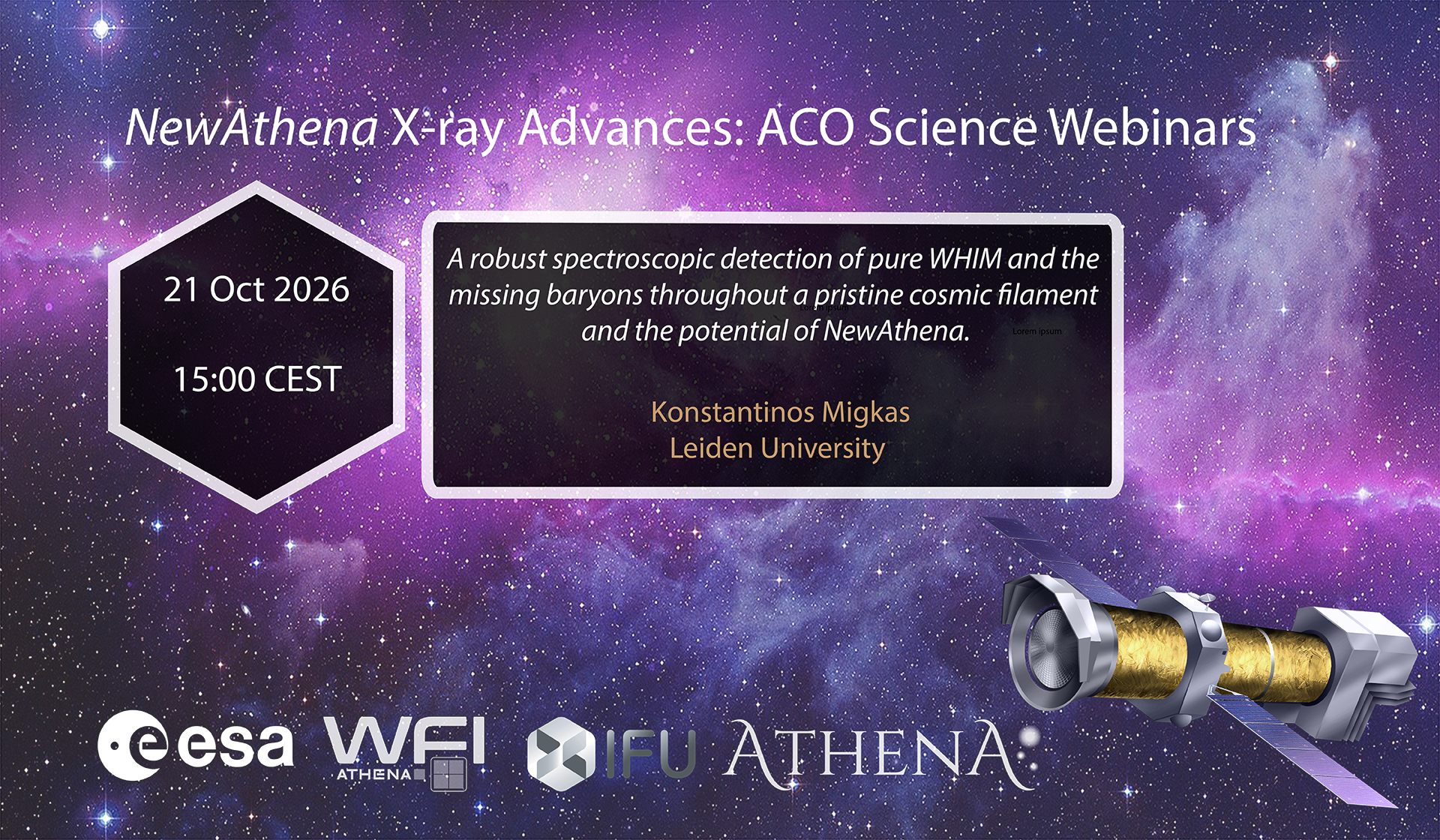
Next webinar 21 October 2026, 15 CEST, by Konstantinos Migkas: A robust spectroscopic detection of pure WHIM and the missing baryons throughout a pristine cosmic filament and the potential of NewAthena.
Abstract: The "missing baryon" problem refers to the fact that a significant fraction of the baryons in the local Universe remains undetected. Cosmological simulations predict that most of them reside in cosmic filaments in the form of the warm–hot intergalactic medium (WHIM), whose faint, diffuse X-ray emission makes it extremely challenging to detect. To date, X-ray WHIM emission has been detected in only a handful of individual filaments, and spectroscopic constraints remain very scarce. In this talk, I present one of the first robust X-ray spectroscopic detection of pure WHIM emission from an individual, pristine filament with a 3D length of 7 Mpc, connecting the cluster pairs A3530/32 and A3528-N/S in the Shapley supercluster. We combine Suzaku, XMM-Newton and ROSAT data to characterise the filament, surrounding clusters, and sky background, and to remove the clusters' contaminating signal from the filament region. Crucially, we use deep XMM-Newton observations to resolve and model the AGN along the filament with a novel technique, removing their emission from the Suzaku data and appropriately modeling any residual emission. Our imaging analysis reveals (21 ± 3)% excess X-ray emission over the sky background throughout the filament, at a 6.1σ level. Spectroscopically, we constrain the gas temperature, electron density and baryon overdensity of the filament to kT ≈ 0.8–1.1 keV, nₑ ≈ 10⁻⁵ cm⁻³ and δ_b ≈ 30–40 at >3σ. This is the first time the measured thermodynamic properties for a single filament fully agree with cosmological simulations. I will also discuss how undetected filaments can bias mass estimates of the local cosmic web. Finally, I will present the prospects for filament studies with NewAthena. The WFI's combination of large collecting area and sharp imaging will enable the discovery and mapping of many more filaments, while resolving the point sources that currently bias filament density estimates. X-IFU will, for the first time, resolve WHIM emission lines, directly measuring the metallicity and velocities of filament gas and reaching cooler, more diffuse phases.
Recorded webinars
They are publicly distributed in this dedicated playlist on the ACO YouTube channel.
Presentations
The PDF versions of the presentations can be downloaded individually at the links given below:
- 31st January 2022: Hendrik van Eerten: Revealing the physics of multi-messenger events using X-rays.
- 23rd February 2022: François Mernier: Unveiling the chemical history of galaxy clusters and the Universe.
- 16th March 2022: Margherita Giustini: Unexpected signals in the X-ray sky: quasi-periodic eruptions from galactic nuclei.
- 28th April 2022: Melanie Habouzit: The AGN population across cosmic time with Athena.
- 25th May 2022: Elisa Costantini: AGN feedback and the connection XRISM-Athena.
- 22nd June 2022: Gabriele Ponti: The circumgalactic medium through Athena's eyes.
- 21st July 2022: Manami Sasaki: Beauty of the Beast: supernova remnants seen in X-rays.
- 28th September 2022: Dominique Eckert: Probing the nature of dark matter with X-ray observations of massive galaxy clusters.
- 26th October 2022: Barbara de Marco: A close-up look at accreting BHs: the innermost regions as seen by Athena.
- 7th December 2022: Ioanna Psaradaki: Mineralogy of interstellar dust: an X-ray overview.
- 22 February 2023: Veronica Biffi: Athena's view of a galaxy cluster major merger.
- 12 April 2023: Sebastien Guillot: Athena's cosmic hunt to discover the riches of neutron star interiors.
- 27 April 2023: Antonis Georgakakis: Forward Modelling the Energetic Universe.
- 29 May 2023: Efrain Gatuzz: Sloshing, merging and feedback velocities in the intracluster medium.
- 28 June 2023: Chris Done: Winds from black hole accretion discs. Silvano Molendi: Apex accretors and the partition of metals in the Universe.
- 29 September 2023: Andrew C. Fabian: Hidden X-ray Cooling Flows in Clusters and Groups of Galaxies.
- 24 October 2023: Elias Kammoun: Probing the X-ray corona-accretion disc connection through thermal reverberation.
- 16 November 2023: Monica Colpi: Electromagnetic counterparts of LISA massive black hole mergers: the next challenge.
- 31 January 2024: Angie Veronica: Characterising the warm-hot filaments in a galaxy cluster system with eROSITA.
- 26 February 2024: Ciro Pinto: The fascinating field of ULXs and why Athena is the way to go.
- 21 March 2024: Fabio Acero: The NewAthena telescope for new scientific perspectives on supernova remnants.
- 2 May 2024: Vittorio Ghirardini: Entropy evolution in cluster outskirts.
- 3 July 2024: Mauro Dadina: A new era for the study of UFOs in AGNs.
- 3 September 2024: Katja Poppenhaeger: Mysteries of exoplanets and low-mass stars and how to shed new X-ray light on them.
- 8 October 2024: Mayura Balakrishnan: Dissecting the Sgr A* Accretion Flow in X-rays with Chandra, and Prospects for NewAthena.
- 7 November 2024: Didier Barret: Deep learning for fitting X-ray spectra.
- 23 January 2025: Norbert Schartel: XMM-Newton: Scientific Strategy.
- 26 February 2025: Labani Mallick: Constraining Disk-to-Corona Power Transfer Fraction, Soft X-ray Excess Origin, & Black Hole Spin Population of Type-1 AGN across Mass Scales.
- 27 March 2025: Irina Zhuravleva: Unveiling Hot Gas Kinematics in Galaxy Clusters with XRISM: Stormy Weather, Multiple Cascades and Calm Outskirts.
- 22 April 20205: Xiaoyuan Zhang: eROSITA view of the WHIM emission in cosmic filaments.
- 20 May 2025: Alessio Marino: So young and yet so cold: constraints on the dense matter Equation of State from three extreme neutron stars.
- 15 October 2025: Paul Scholz: The search for X-ray emission from Fast Radio Burst: current status and future prospects.
- 13 November 2025: Martin Mayer: X-raying the Stellar Graveyard: Mapping Supernova Remnants with eROSITA
- 22 January 2026: Liyi Gu: Catching the wind: detection of an ultrafast outflow launch with XRISM
- 24 February 2026: Brian McNamara: XRISM’s New Perspective on the X-ray Atmospheres of Galaxy Clusters.
- 31 March 2026: Nathalie Degenaar: A Crazy Jet Experiment. How Thermonuclear Bombs Can Reveal Jet Physics.
- 28 April 2026 Arne Rau: The eROSITA Population of Tidal Disruption Events.
- 21 May 2026 Anna L. Watts: Ultradense matter in neutron stars: from NICER to NewAthena.
- 24 June 2026 Yuki Omiya: Elucidation of intra-cluster medium dynamics of merging clusters with XRISM/Resolve.
- 22 October 2026 Konstantinos Migkas: A robust spectroscopic detection of pure WHIM and the missing baryons throughout a pristine cosmic filament and the potential of NewAthena.
Code of conduct
All participants in the seminar series are expected to behave professionally and respectfully with other colleagues. Some basic guidelines are:
- Behave professionally. Refrain from harassment in any form, avoiding offensive comments about individual characteristics, for example, age, gender, sexual orientation, disability, physical appearance, race, nationality or religion.
- Ensure all communications are appropriate for a professional audience, taking into account the many different backgrounds of the participants. For example, sexual or sexist language and imagery are not appropriate.
- Be respectful and do neither insult the participants or the facilitators of the webinars.
- Critique ideas, not people.
Based on the code of conduct of XMM-Newton workshops.
Scientific Organising Committee
Laura Brenneman (CfA), Nanda Rea (ICE-CSIC), Aurora Simionescu (SRON), and the Athena Community Office (ACO).