


NewAthena Research Highlights #7
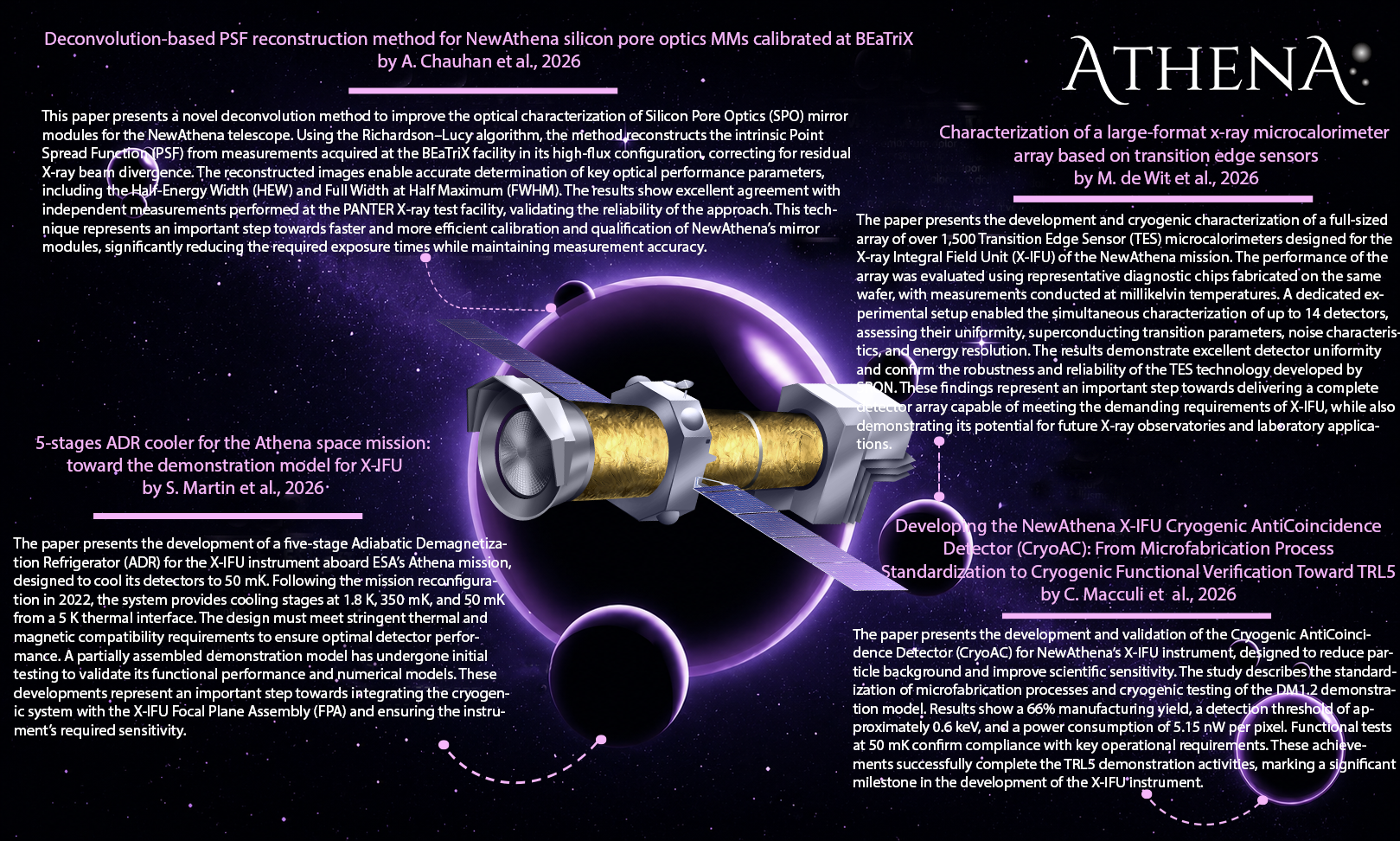
Four recent scientific publications highlight significant progress in the development and validation of key technologies for ESA’s NewAthena mission, bringing the observatory closer to achieving its ambitious scientific objectives. These studies showcase important advances in the performance and characterization of the X-ray Integral Field Unit (X-IFU) detectors, including the successful cryogenic testing of large arrays of Transition Edge Sensor (TES) microcalorimeters and the validation of the Cryogenic AntiCoincidence Detector (CryoAC), which has completed the demonstration activities towards Technology Readiness Level 5 (TRL5). Further progress has been achieved in the development of the advanced cryogenic cooling system required to operate X-IFU detectors at temperatures as low as 50 mK, as well as in innovative calibration techniques for NewAthena’s Silicon Pore Optics (SPO), enabling more efficient and accurate optical characterization. Together, these achievements represent important milestones in the technological development of NewAthena, reflecting the continued efforts and international collaboration of the scientific and engineering teams working to equip the mission with the capabilities needed to explore the hot and energetic Universe.